
Choosing a Feeder
Step Feeder vs. Vibratory Bowl Feeder: How to Tell Which One Your Part Needs
Step feeder vs. vibratory bowl feeder: a bowl is the right answer most of the time, and the wrong one often enough that it is worth knowing the difference before you spec a system.
Most parts-feeding conversations open with someone asking for a bowl feeder, and the step feeder vs. vibratory bowl feeder question only comes up once the part forces it. Usually the bowl is the right instinct. A vibratory bowl is the most flexible, most proven way to take a pile of loose parts and hand them downstream one at a time in a known orientation. But there is a whole category of parts where a bowl is the wrong tool, and it is worth knowing which side of that line your part sits on before the system is specified — because the two machines do not look alike, do not occupy the same floor space, and do not cost the same to build.
What a bowl actually does
A vibratory bowl feeder works by tumbling. Parts climb a spiral track on the inside wall of the bowl, and as they climb they pass tooling — ledges, cut-outs, air jets, wipers — that rejects any part not sitting the way you want it. A rejected part drops back into the pile and tries again. After enough passes, every part leaving the bowl is oriented identically.
That mechanism is exactly what makes bowls so good. The orientation logic is passive and mechanical: once the bowl is tooled for your part, it holds that orientation for years with no software, no sensors and no per-cycle cost. It is also exactly what makes a bowl wrong for some parts.
Four things that push a job out of bowl territory
- Weight. Heavy parts do not climb a vibratory track willingly. Getting them up the spiral means driving the bowl harder, which means more amplitude, more noise and more wear on the tooling they are dragging across.
- Surface finish. Tumbling is contact, and contact repeats until the part happens to land right. A machined, plated, painted or polished part can arrive at the outfeed marked by the process that oriented it.
- Elevation. A bowl orients; it does not lift much. If the operator loads at waist height and the downstream conveyor sits at 40 inches, that gap is vertical travel, and vertical travel is not what a bowl is for.
- Size. Past a certain part envelope, the bowl diameter required to give the part room to turn over stops being practical — for the floor space it eats, for the energy it takes to drive, and for the noise it makes doing it.
A recent job hit three of the four at once. A steel manufacturer needed two flange sizes, 2-inch and 3/4-inch, delivered flat-side down to a packaging line at a 40-inch outfeed height, from a hopper an operator could fill at waist level with a full box and then walk away from. Steel flanges are heavy. Bowl tumbling would have marred them. And 40 inches from a waist-level load is elevation, not orientation. That job was never a bowl job.
What a step feeder does instead
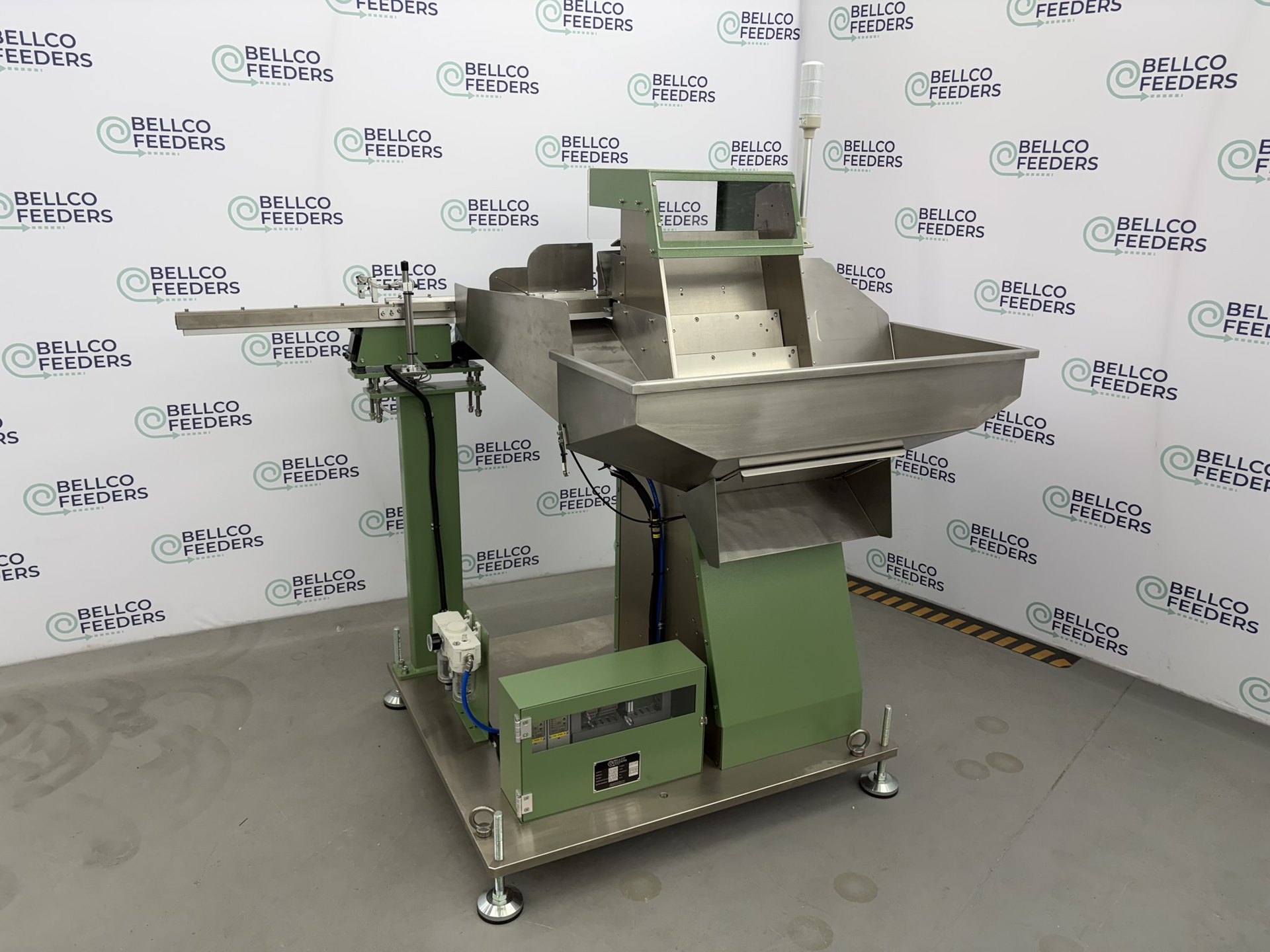
A step feeder (some buyers call it a stepper feeder) does not tumble. Parts sit in a hopper at the bottom of the machine, and a set of stepped plates rises and falls, lifting a small quantity one tier at a time until the top tier delivers onto a linear track. Each part is carried, not churned. There is no repeated contact against tooling, and the elevation is not an add-on — the steps are the lift.
The orientation work then happens on the linear track after the steps rather than inside a bowl. On the flange job that was a 550mm vibratory linear track that laid each flange flat-side down before it reached the discharge. On a tapered-tube job it was a 300–400mm track with an inspection station over it. The step mechanism gets the part up and out of the pile; the track decides which way it faces.
What you give up
Step feeders trade peak rate for gentleness and lift. A bowl tooled for a small part can run several times faster than a step feeder handling something heavy. The two flange feeders run at 25 parts per minute each; a 500mm bowl on the right part will run 60 to 120. If your line needs high rate on a small, robust part, the bowl is not just acceptable, it is better.
The footprint is different too. A bowl system is wide and low. A step feeder is taller and narrower, which is often the better shape for a cell that is short on floor space and long on headroom — but it is a different shape, and it needs to be drawn into the layout before anything is fabricated, not after.
Step feeder vs. vibratory bowl feeder at a glance
| Factor | Step feeder | Vibratory bowl feeder |
|---|---|---|
| Part weight | Built for heavy parts. The steps carry them up; nothing has to climb a vibrating track. | Light to medium parts. Heavy parts mean driving the bowl harder, with more noise and more tooling wear. |
| Surface finish and marking | Virtually no part-on-part contact, so machined, plated and cosmetic finishes arrive clean. | Parts tumble until they land right. Contact is how a bowl orients, so finished parts can be marked. |
| Part size | A quarter-inch up to 14 inches long, with steps from 6 to 20 inches. | Small to medium parts. Big parts need a big bowl to turn over in. |
| Lift from load height to outfeed | The steps are the lift: a waist-level load to a 40-inch outfeed on the flange job. | Orients but lifts little. Height usually comes from a pre-feeder or elevated hopper. |
| Peak feed rate | Lower. The flange feeders run 25 parts per minute each. | Higher. A 500mm bowl on the right part runs 60 to 120. |
| Noise | A fraction of the noise of a bowl: pneumatic steps, no shaker. | A vibratory feeder works by vibrating, so noise has to be designed down with isolators, coatings or an enclosure. |
| Footprint | Taller and narrower. Suits a cell short on floor space and long on headroom. | Wide and low. |
| Where orientation happens | On the linear track after the steps, with a vision camera when the part’s ends are hard to tell apart. | Inside the bowl, through tooling machined to the part. |
| Tooling and changeover | Steps, hopper and track sized to the part, in tabletop or standalone units. | Gates, rails and wipers machined to one part geometry. A different part usually means different tooling. |
| What drives the cost | Step size and count, hopper capacity, and what goes on the track after it. | Bowl size and material, how complex the tooling is, and the feed rate. |
Three jobs that were never bowl jobs
Heavy steel flanges to a 40-inch outfeed. The flange job above became two step feeders feeding steel flanges, one per size, set back to back in the customer’s cell. Each lifts from a 250-piece hopper at waist height to the 40-inch outfeed, and a 550mm linear track lays every flange flat-side down at 25 parts per minute. The operator dumps in a box and leaves it alone; a stack light says when to refill.
Actuator pins where the two ends look almost the same. A machine integrator needed three lengths of dual-pointed actuator pin, all the same diameter, with the tapered end leading every time. Track tooling could not reliably tell the ends apart, so the answer was a vision-guided step feeder: a tabletop unit lifts the pins onto a 700mm track, a Keyence IV camera reads which end is leading, a purge gate sends the wrong ones back to the hopper, and a rotary escapement stands each pin upright for the robot.
Tapered tubes into two different cells. One cell could take a tube with either end leading; the other needed the nose end first on every cycle. Bellco built paired step feeders with a bi-directional escapement on one proposal: a tabletop unit for the first cell, and a standalone unit for the second with a Keyence IV-4 camera that blows off tail-first tubes before a dual-stage escapement pitches each part left or right on PLC command. Both run at 33 parts per minute.
The short version
Specify a bowl when the part is small to medium, tolerant of contact, and the rate matters more than the finish. Specify a step feeder when the part is heavy, marks easily, is too large to turn over comfortably, or has to be lifted from a floor-level or waist-level load to a fixed outfeed height — and when you want an operator to dump a box in and leave it alone.
Most of the time the part answers the question by itself. When it does not, send us the part or the drawing, the rate you need, the orientation the next machine expects, and the height it has to arrive at. Those four things are enough for us to tell you which machine you are actually buying.
Frequently asked questions
When should I use a step feeder instead of a vibratory bowl feeder?
When the part is heavy, has a finish that marks, is too large to turn over in a practical bowl, or has to be lifted from a waist-level load to a fixed outfeed height. As a rule of thumb, parts over 7 to 8 inches, plated or cosmetic parts, and staffed cells with a noise limit point to a step feeder. Small, robust parts that need a high rate point to a bowl.
Is a step feeder quieter than a bowl feeder?
Yes. A step feeder moves parts on pneumatic steps with no shaker and no ringing steel, so it produces a fraction of the noise of a vibratory bowl feeder. That is one reason step feeders suit medical, electronics and staffed work cells.
How fast can a step feeder run?
Slower than a bowl on a small part. The two flange feeders run at 25 parts per minute each and the tapered-tube systems at 33, where a 500mm bowl on the right part runs 60 to 120. The rate depends on the part, the step size and what the track has to do afterwards, and it is proven on video at the factory acceptance test before the system ships.
What size parts can a step feeder handle?
Parts from a quarter-inch up to 14 inches long, with step sizes from 6 to 20 inches. Tabletop units cover compact, lower-volume jobs; standalone units have larger steps and their own leveling feet for bigger parts and higher capacity.
Can a step feeder orient parts, or does it only lift them?
The steps lift; the orientation happens on the linear track after them. On the flange job a 550mm track laid each flange flat-side down. Where the two ends of a part are too similar for track tooling to separate, a vision camera checks each part in flight and the wrong ones are returned to the hopper.
Is a step feeder more expensive than a bowl feeder?
Both are priced by the part, so there is no flat answer. A bowl’s cost is driven by its size, material and tooling; a step feeder’s by its step size, hopper capacity and what goes on the track after it. Send us the part and the rate, and we will tell you which machine fits before you pay for either.