Case Study: Two Stand-Alone Step Feeders — Back to Back — for High-Volume Steel Flange Production
Bellco Feeders created two stand-alone step feeders — back to back
— for high-Volume steel flange production
| Industry: | Steel Manufacturing / Industrial Packaging |
| Parts: | 2-Inch Steel Flange + ¾-Inch Steel Flange (two systems, one proposal) |
| Feed Rate: | 25 PPM per feeder |
| Key Feature: | Stand-alone step feeders with built-in hoppers, stack-light low-level indication, and fully guarded actuator backs |
| System: | Two identical step feeders, sized for each flange diameter, 550mm vibratory linear track outfeed |
| Voltage/Controller: | 110V or 220V · CUH Variable Frequency Digital (PNP) |
| Hopper: | 250-Piece Capacity Vibratory Hopper per feeder |
The Challenge
A steel manufacturing customer needed to feed two different flange sizes — 2-inch and ¾-inch — into a downstream packaging line. Both flanges had to arrive at a precise 40-inch outfeed height, oriented flat-side down, ready to drop onto two small belt conveyors. The customer wanted to dump a full box of flanges into a hopper at waist level, walk away, and let the system run.
A vibratory bowl feeder wasn't the right tool for the job. Steel flanges are heavy, the tumbling motion of a bowl would mar them, and reaching the 40-inch outfeed height from a waist-level load required vertical elevation, not just orientation. The customer needed step feeders — and they needed two of them, one per flange size, that could sit back-to-back in their production cell without taking up more floor space than necessary.
There's a catch. Step feeders are a category that most parts-feeding companies don't build. The mechanics are different from vibratory bowls, the engineering challenges are different, and the demand is niche enough that most shops don't invest in the capability. That left the customer looking for a specialized partner.
The Solution: Two Step Feeders, Same Engineering, Different Sizes
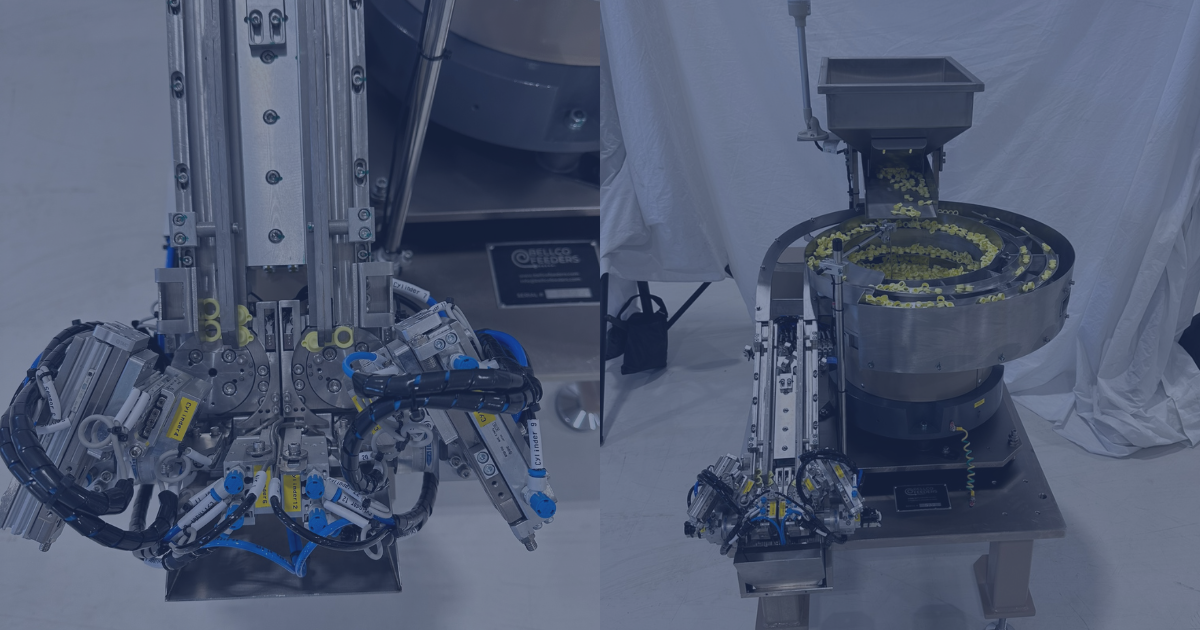
Bellco designed and built two stand-alone step feeders to the customer's exact requirements — one sized for the 2-inch flange, one for the ¾-inch flange. Both systems share the same engineering DNA: a 250-piece capacity vibratory hopper at waist height, a step mechanism that elevates parts one tier at a time without tumbling or marring, and a 550mm vibratory linear track that orients each flange flat-side down for clean downstream pickup.
Critically, the backs of both units — where the step actuators move — are fully enclosed. Operators load the hopper from the front and never come into contact with moving parts. A stack light mounted on the hopper guarding indicates when parts are low, so the operator knows when to refill without having to walk over and check. Each unit sits on rolling casters with adjustable leveling feet, so the customer can roll the feeders into position back-to-back, level them, and start running.
Every dimension — outfeed height, hopper capacity, footprint, integration to the customer's downstream conveyors — was modeled in SolidWorks before any metal was cut. The customer received the complete 3D models for review and approval before fabrication started.
Engineering Highlights
Step feeders are a Bellco specialty. Where most parts-feeding companies build only vibratory bowls, Bellco invested in the engineering capability to build true step feeders — because heavy parts, large parts, and elevation-from-floor-level applications need a different solution than a bowl can provide. These two units are textbook examples: high-quality 304 stainless construction, CUH variable-frequency digital controllers in a lockable enclosure, Keyence shortage sensors with full system stop on low-part conditions, SMC pneumatics throughout, and a 38mm nickel-plated steel baseplate with rolling casters and leveling feet that lets the customer position and re-position the units as their line evolves.
Safety guarding on the back of the unit isn't an upcharge — it's how Bellco builds step feeders. Operator safety is baked in from the design phase, not bolted on afterward.
Full System Overview (Per Feeder)
- Stand-alone vibratory step feeder, sized to part diameter (2" or ¾")
- 25 PPM feed rate, 250-piece capacity vibratory hopper
- 550mm vibratory linear track outfeed, lying-flat-on-closed-side orientation
- Step mechanism elevates parts from waist-height load to 40" outfeed
- Fully enclosed actuator guarding on the back of the unit for operator safety
- Stack light mounted on hopper guarding indicates low-part condition
- 38mm nickel-plated steel baseplate on rolling casters with adjustable leveling feet
- CUH variable-frequency digital controllers (PNP), housed in a lockable control box
- Keyence shortage sensor with full stopping function
- SMC pneumatics throughout, 110V or 220V power options
- Fully designed and modeled in SolidWorks — 3D model provided to customer for approval before build
The Result
✅Two stand-alone step feeders, sized for each flange diameter, delivered to spec
✅ 25 PPM per feeder, parts oriented flat-side down for clean downstream pickup
✅ Back-to-back footprint that fits the customer's existing production cell
✅ Waist-height load, 40-inch outfeed — operator workflow unchanged from box to belt
✅ Stack-light low-level indication keeps the line running without manual checks
✅ Fully enclosed actuator guarding — operator safety designed in, not bolted on
✅ One-year warranty included on both systems
Typical lead time is 12–14 weeks from order to shipment.
Instead of a rotary escapement, this system uses strategically placed blow-off nozzles and fiber optic sensors inside the bowl to orient parts accurately, reducing mechanical complexity and maintenance needs.
Yes. This system includes features like a Keyence sensor for parts flow monitoring, a PNP CUH variable frequency controller, and a fully wired control box — all designed for seamless integration into high-speed, robot-assisted medical device assembly lines.