
Case Study
One Frame, Five Feeders, Under 80 Decibels: Vibration Mitigation That Saves Space and Cost
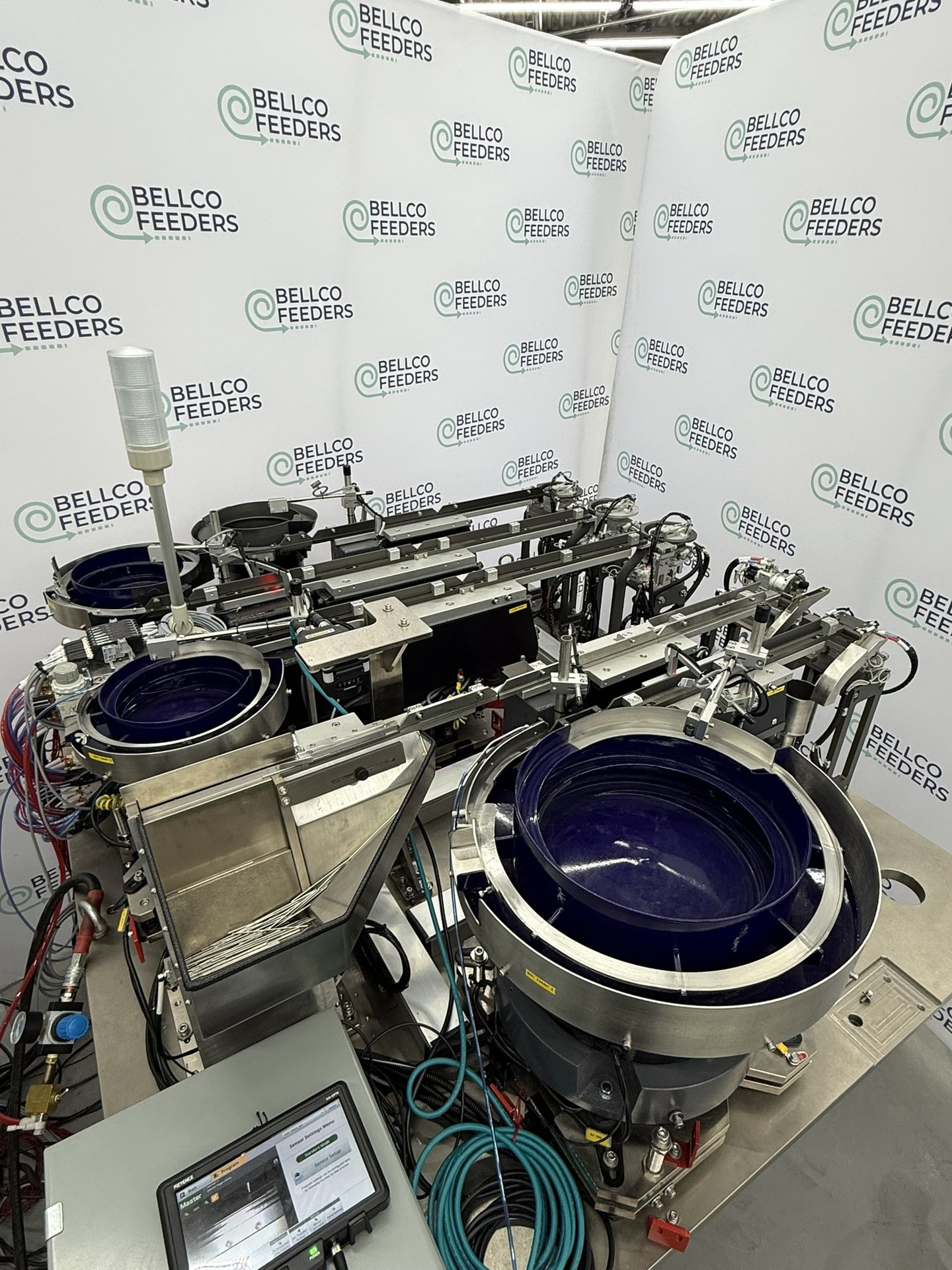
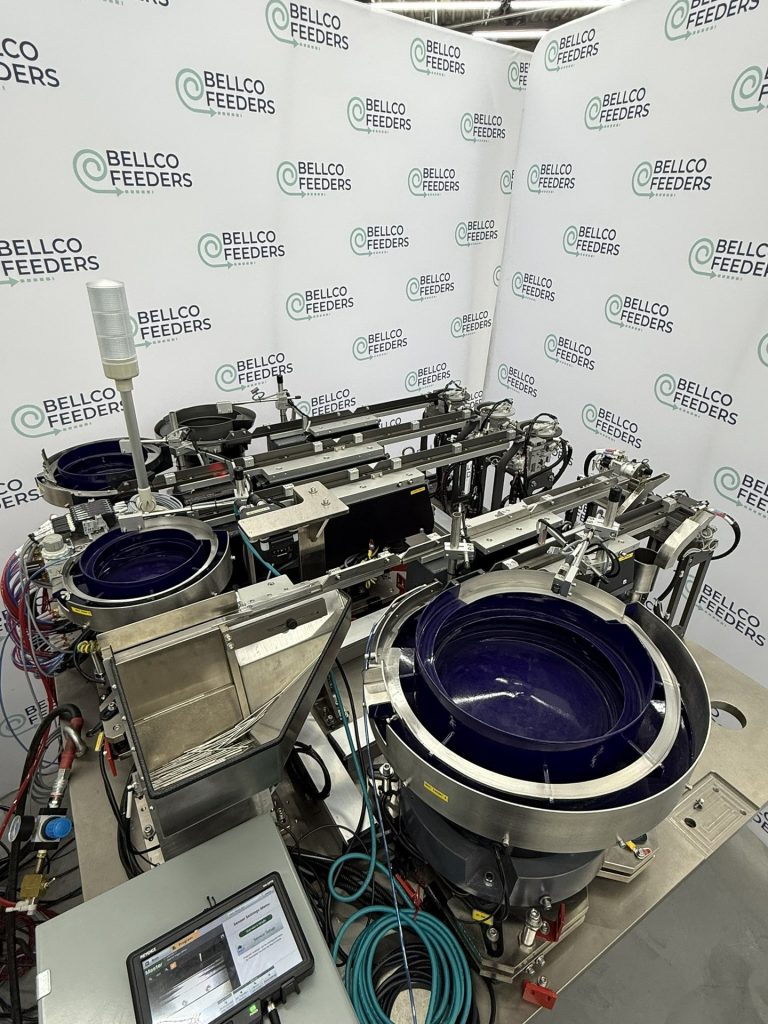
Five feeders into one robotic assembly cell, on a single shared baseplate instead of five separate machines — and quieter than most single-bowl feeders.
The Challenge
A machine integrator needed five different parts fed into one robotic assembly cell — four part types best handled by vibratory bowls, plus one part better suited to a step feeder. Different sizes, different orientations, different feed rates. The conventional approach: build five separate feeder systems, each on its own baseplate, and find floor space for all of them.
That approach has two problems. First, floor space is expensive — five separate machines means five separate footprints in a robotic cell that's already tight. Second, cost adds up fast — five frames, five sets of legs, five sets of casters, five separate installations.
The customer asked the question most integrators don't get to ask: could Bellco put all five feeders on a single shared baseplate?
The Solution
Yes — and the reason it works is Bellco's vibration mitigation engineering. Vibratory feeders work because they vibrate. The trick to mounting five of them on the same frame is making sure each feeder's vibration stays in that feeder, and doesn't crosstalk into its neighbors.
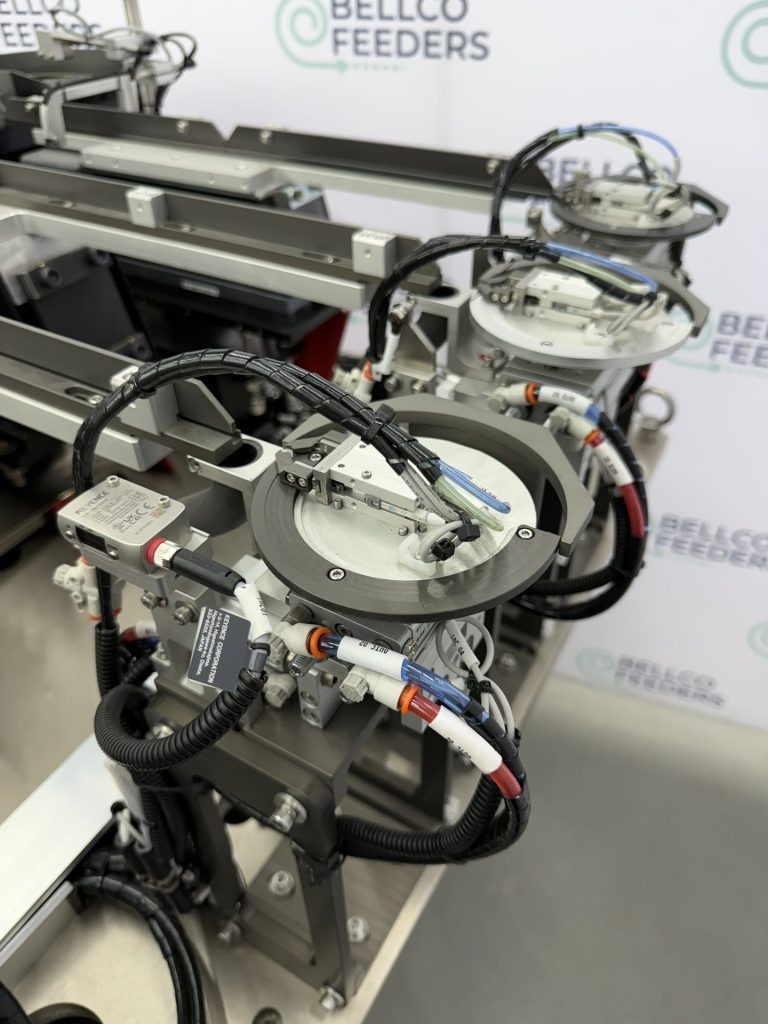
Bellco solves this with rubber-dampening isolators between each feeder and the shared baseplate, plus individual sub-plates that further isolate each unit. Every feeder gets its own floating mounting that absorbs vibration before it can transmit through the frame. The bowls run independently — no interference, no harmonic feedback — even with all five running simultaneously.
The customer saves significant floor space, saves the cost of four extra frames and bases, and gets one integrated unit that's easier to install, easier to maintain, and easier to integrate with their robotic cell.
Quieter Than Most Single-Bowl Feeders
Five vibratory feeders running at once should sound like a factory. This system runs under 80 decibels — quieter than most single-bowl feeders from the competition. Three engineering choices got us there.
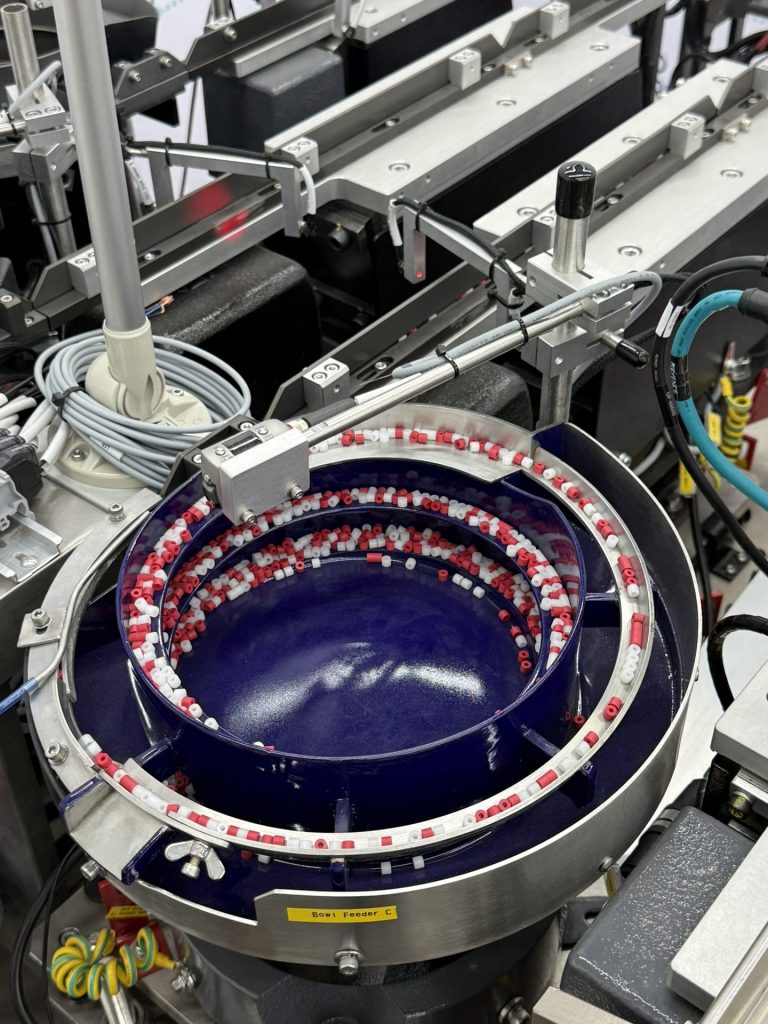
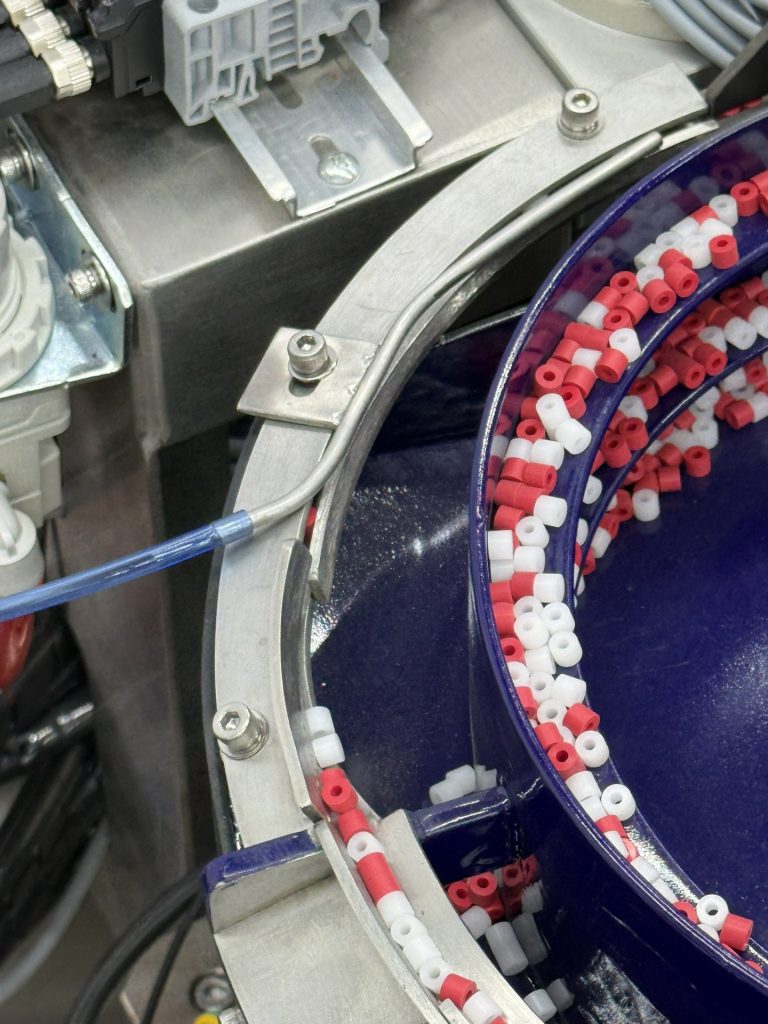
First, polyurethane bowl coatings. The bowls themselves don't ring — the coating absorbs the high-frequency component of vibratory sound that most stainless bowls give off. Second, the same rubber isolators that prevent vibration crosstalk also absorb sound at its source, before it can transmit into the frame and amplify. Third, acoustic shrouds around the noisier sections of the system contain what little sound is left.
The result is a system that doesn't dominate the cell acoustically. Operators can work next to it. Conversations are possible. That matters more than the spec sheet usually acknowledges.
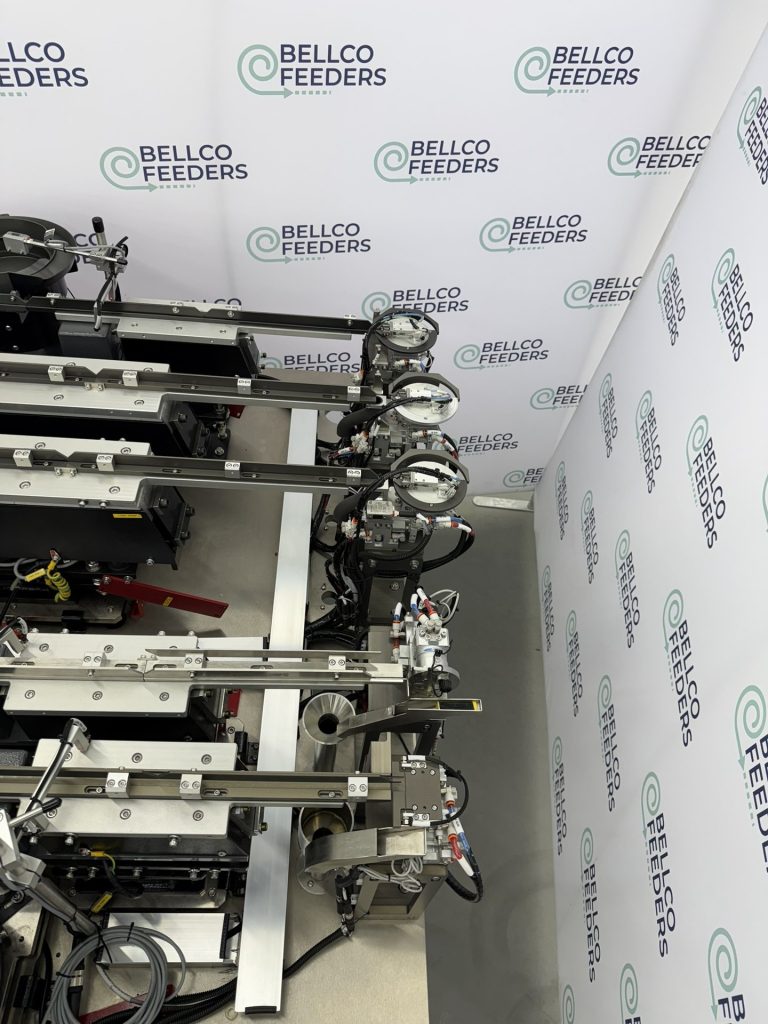
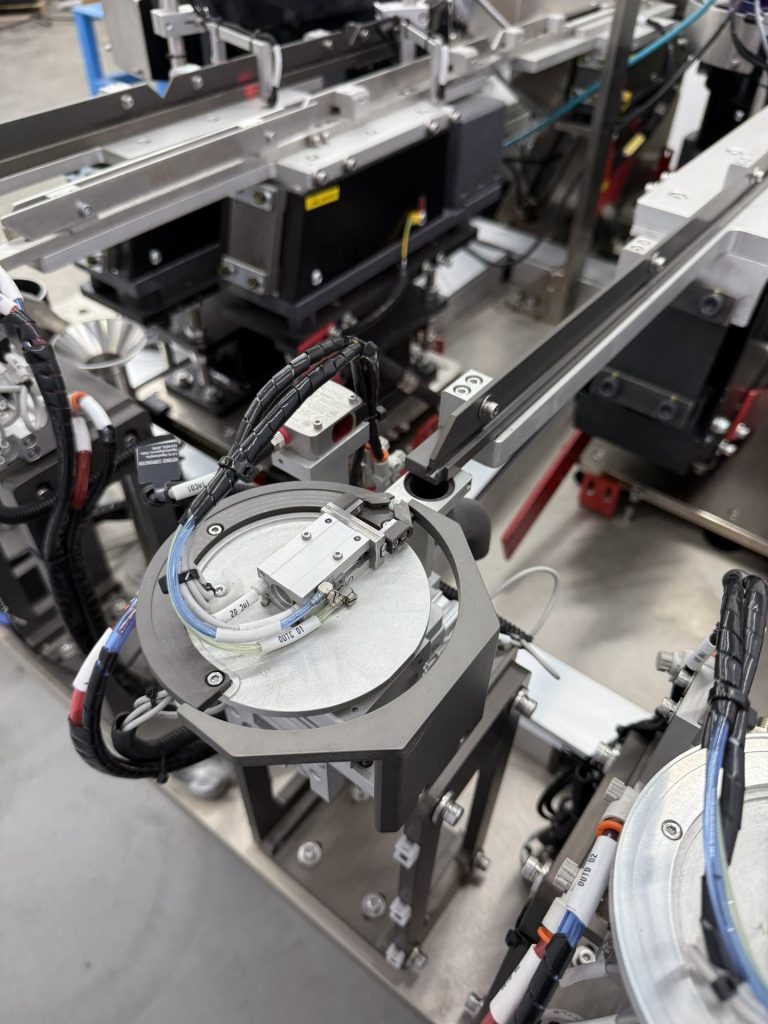
Every bowl outfeed ends in a horizontal rotating escapement — a custom Bellco design where the singulated part sits in a fixed pick position. From above, a robot drops down and presses a pin through the bottom of the escapement, pushing the part up and out to its gripper. The escapement holds the part precisely in place during the press, so the robot doesn't need vision to find it, and doesn't need a complex tooling change to handle the different part variants.
Full System Overview
- Four vibratory feeder bowls (two 300mm, two 220mm) plus one tabletop step feeder
- Single shared 38mm nickel-plated steel baseplate
- Rubber-dampening isolators plus individual sub-plates per feeder for vibration isolation
- Polyurethane bowl coatings (~1mm) on all bowls — quiet operation, mark-free part handling
- Acoustic shrouds on the noisier sections of the system
- Under 80 dB total noise with all five feeders running
- Horizontal rotating escapement per bowl — robot pin pressed through bottom for pick
- CUH variable-frequency digital controllers (PNP), one per feeder, all in lockable enclosures
- Keyence shortage sensors with full stopping function on each feeder
- SMC pneumatics throughout, 110V or 220V power options
- Fully designed and modeled in SolidWorks — complete 3D model provided to customer for approval before fabrication
- One-year warranty included
The Build
Have a similar project in mind?
Send us the part, the rate, and what has to happen to it downstream. An engineer will come back inside five business days.