
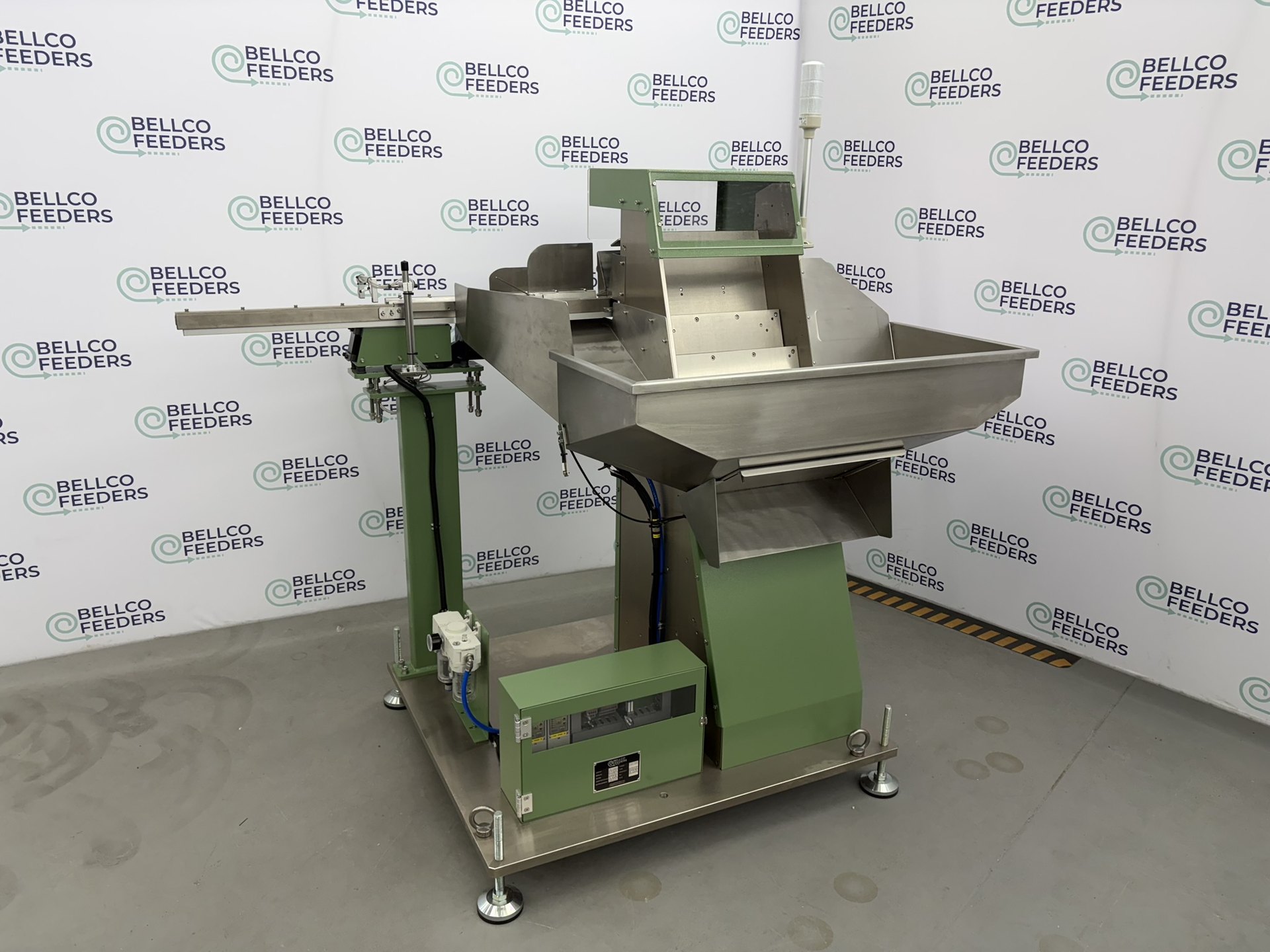
Choosing a Feeder
Bowl or Step Feeder? How to Tell Which One Your Part Needs
A vibratory bowl is the right answer most of the time, and the wrong one often enough that it is worth knowing the difference before you spec a system.
Most parts-feeding conversations open with someone asking for a bowl feeder. Usually that is the right instinct. A vibratory bowl is the most flexible, most proven way to take a pile of loose parts and hand them downstream one at a time in a known orientation. But there is a whole category of parts where a bowl is the wrong tool, and it is worth knowing which side of that line your part sits on before the system is specified — because the two machines do not look alike, do not occupy the same floor space, and do not cost the same to build.
What a bowl actually does
A vibratory bowl feeder works by tumbling. Parts climb a spiral track on the inside wall of the bowl, and as they climb they pass tooling — ledges, cut-outs, air jets, wipers — that rejects any part not sitting the way you want it. A rejected part drops back into the pile and tries again. After enough passes, every part leaving the bowl is oriented identically.
That mechanism is exactly what makes bowls so good. The orientation logic is passive and mechanical: once the bowl is tooled for your part, it holds that orientation for years with no software, no sensors and no per-cycle cost. It is also exactly what makes a bowl wrong for some parts.
Four things that push a job out of bowl territory
- Weight. Heavy parts do not climb a vibratory track willingly. Getting them up the spiral means driving the bowl harder, which means more amplitude, more noise and more wear on the tooling they are dragging across.
- Surface finish. Tumbling is contact, and contact repeats until the part happens to land right. A machined, plated, painted or polished part can arrive at the outfeed marked by the process that oriented it.
- Elevation. A bowl orients; it does not lift much. If the operator loads at waist height and the downstream conveyor sits at 40 inches, that gap is vertical travel, and vertical travel is not what a bowl is for.
- Size. Past a certain part envelope, the bowl diameter required to give the part room to turn over stops being practical — for the floor space it eats, for the energy it takes to drive, and for the noise it makes doing it.
A recent job hit three of the four at once. A steel manufacturer needed two flange sizes, 2-inch and 3/4-inch, delivered flat-side down to a packaging line at a 40-inch outfeed height, from a hopper an operator could fill at waist level with a full box and then walk away from. Steel flanges are heavy. Bowl tumbling would have marred them. And 40 inches from a waist-level load is elevation, not orientation. That job was never a bowl job.
What a step feeder does instead
A step feeder does not tumble. Parts sit in a hopper at the bottom of the machine, and a set of stepped plates rises and falls, lifting a small quantity one tier at a time until the top tier delivers onto a linear track. Each part is carried, not churned. There is no repeated contact against tooling, and the elevation is not an add-on — the steps are the lift.
The orientation work then happens on the linear track after the steps rather than inside a bowl. On the flange job that was a 550mm vibratory linear track that laid each flange flat-side down before it reached the discharge. On a tapered-tube job it was a 300–400mm track with an inspection station over it. The step mechanism gets the part up and out of the pile; the track decides which way it faces.
What you give up
Step feeders trade peak rate for gentleness and lift. A bowl tooled for a small part can run several times faster than a step feeder handling something heavy. The two flange feeders run at 25 parts per minute each; a 500mm bowl on the right part will run 60 to 120. If your line needs high rate on a small, robust part, the bowl is not just acceptable, it is better.
The footprint is different too. A bowl system is wide and low. A step feeder is taller and narrower, which is often the better shape for a cell that is short on floor space and long on headroom — but it is a different shape, and it needs to be drawn into the layout before anything is fabricated, not after.
The short version
Specify a bowl when the part is small to medium, tolerant of contact, and the rate matters more than the finish. Specify a step feeder when the part is heavy, marks easily, is too large to turn over comfortably, or has to be lifted from a floor-level or waist-level load to a fixed outfeed height — and when you want an operator to dump a box in and leave it alone.
Most of the time the part answers the question by itself. When it does not, send us the part or the drawing, the rate you need, the orientation the next machine expects, and the height it has to arrive at. Those four things are enough for us to tell you which machine you are actually buying.