
Automation
Feeding a Robot That Picks Two Parts at a Time
The robot cycle sets the feeder specification, not the other way round. If it takes two parts every six seconds, the feeder has to present two parts at a fixed pitch in a fixed place, every six seconds.
A feeding enquiry that opens with “we need twenty parts a minute” is half a specification. Twenty parts a minute onto the floor is easy. Twenty parts a minute into a robot’s gripper, two at a time, in the same position every cycle, is a machine.
The rate is the easy part
A custom-tooled 1100mm stainless bowl running machined metal components at 20 PPM is not working hard. Getting oriented parts to the end of a linear track is the part of the job that a bowl feeder has been good at for sixty years. It is what happens in the last six inches that decides whether the cell runs.
What the robot actually needs
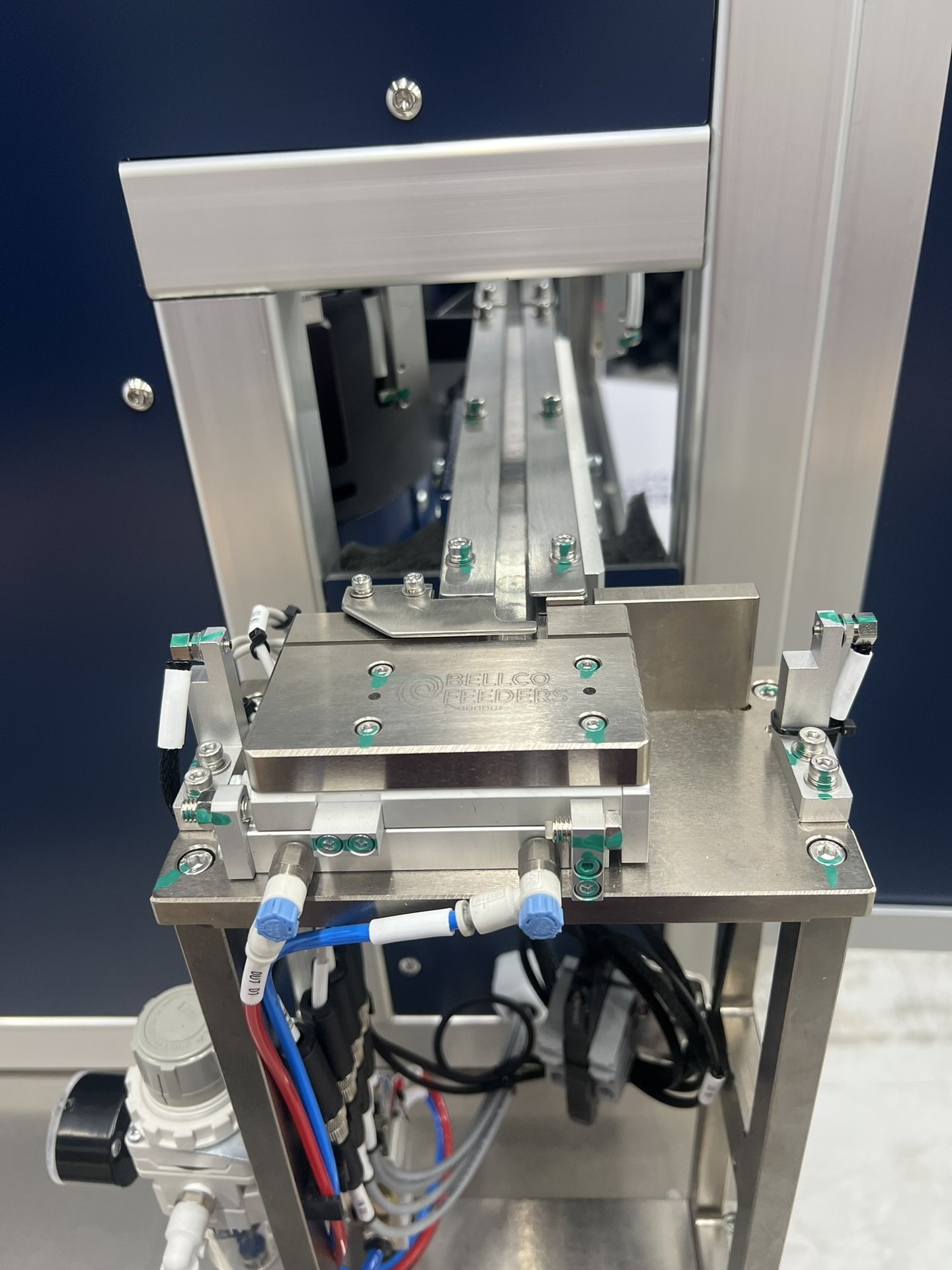
On this system the robot picks two parts at once, every six seconds. Working backwards, that means the feeder has to deliver two parts, spaced 200mm apart so the gripper’s two jaws clear each other, held in a known position, on a six-second cadence. A gripper closing on air is a fault that stops the cell. A gripper closing on a part that has drifted a few millimeters is a part on the floor.
None of that is a rate problem. It is a presentation problem, and presentation is what an escapement does.
That is what the escapement is for
A side shuttle escapement takes the continuous stream coming off the linear track and turns it into discrete, spaced, positioned presentations. It holds each part in a nest at a fixed location, releases on the signal, and sets the pitch between parts. Because the part is held rather than merely queued, the robot does not need vision to find it and does not need to hunt for it.
The pitch is a real design input, not a detail. 200mm on this cell came from the gripper geometry, and it is the number that let one pick take two parts instead of two picks taking one each — which is to say it halved the robot’s cycle count for the same throughput.
Three parts of the spec people leave out
- Hopper capacity is measured in time, not parts. “4.5 cubic feet” tells an operator nothing. “About an hour of hands-free running at 20 PPM” tells them when they have to come back, which is the only number they care about.
- The end-of-track sensor and where its signal goes. On this system it is wired into an I/O block the integrator lands directly in their existing equipment. That is the difference between a feeder that arrives ready to run and one that arrives needing its own controls project.
- Orientation is a bowl-tooling problem, not a downstream one. Directional machined and stamped components get sorted inside the bowl by tooling cut for that geometry. If the tooling is right, the escapement only has to space and hold. If it is not, no amount of downstream cleverness rescues it.
What to send us
The robot cycle time, how many parts come off each pick, the pitch the gripper needs between them, and how long you want to go between refills. Those four numbers describe the machine far better than a parts-per-minute figure does — and they are the ones we will ask for first.