
Engineering
Why a Vibratory Track Cannot Hold a Speed
A vibratory track moves parts by friction and part-to-part contact, so the back of the queue always travels slower than the front. Usually that is fine. Occasionally it decides the job.
Almost every feeding specification is about two things: what orientation the part has to arrive in, and how many of them per minute. Occasionally a third requirement turns up that changes the machine entirely — something downstream cares how fast each part is traveling. That is a different problem, and a vibratory track is the wrong tool for it.
How a vibratory track actually moves a part
A linear track works the same way the bowl does: it vibrates, and each part hops forward a fraction of a millimeter at a time. In a full track the parts are also pushing each other along, so how fast any given part is traveling depends on where it sits in the queue and how much weight is behind it. The parts at the back are always a little slower than the parts at the front.
Across a shift that variance averages out and nobody ever measures it. It only matters when something downstream fires on a signal rather than on the part arriving.
Where it becomes the whole problem
An electrical terminal manufacturer dispenses brazing paste — a precise dot of metal-filled compound — onto copper ring terminals traveling toward a brazing furnace. The dispenser fires on a sensor signal. Fire too early and the paste smears; too late and it misses the part. The only way the timing works is if every terminal passes that sensor at the same velocity.
At 120 parts per minute, the speed the brazing line required, the ordinary variance in a vibratory track is the difference between a good braze and a rejected part. And there were eight terminal variants — different barrel diameters, different overall lengths — all of which had to run without retooling and without recalibrating the dispenser between them.
The fix is to leave the vibratory environment
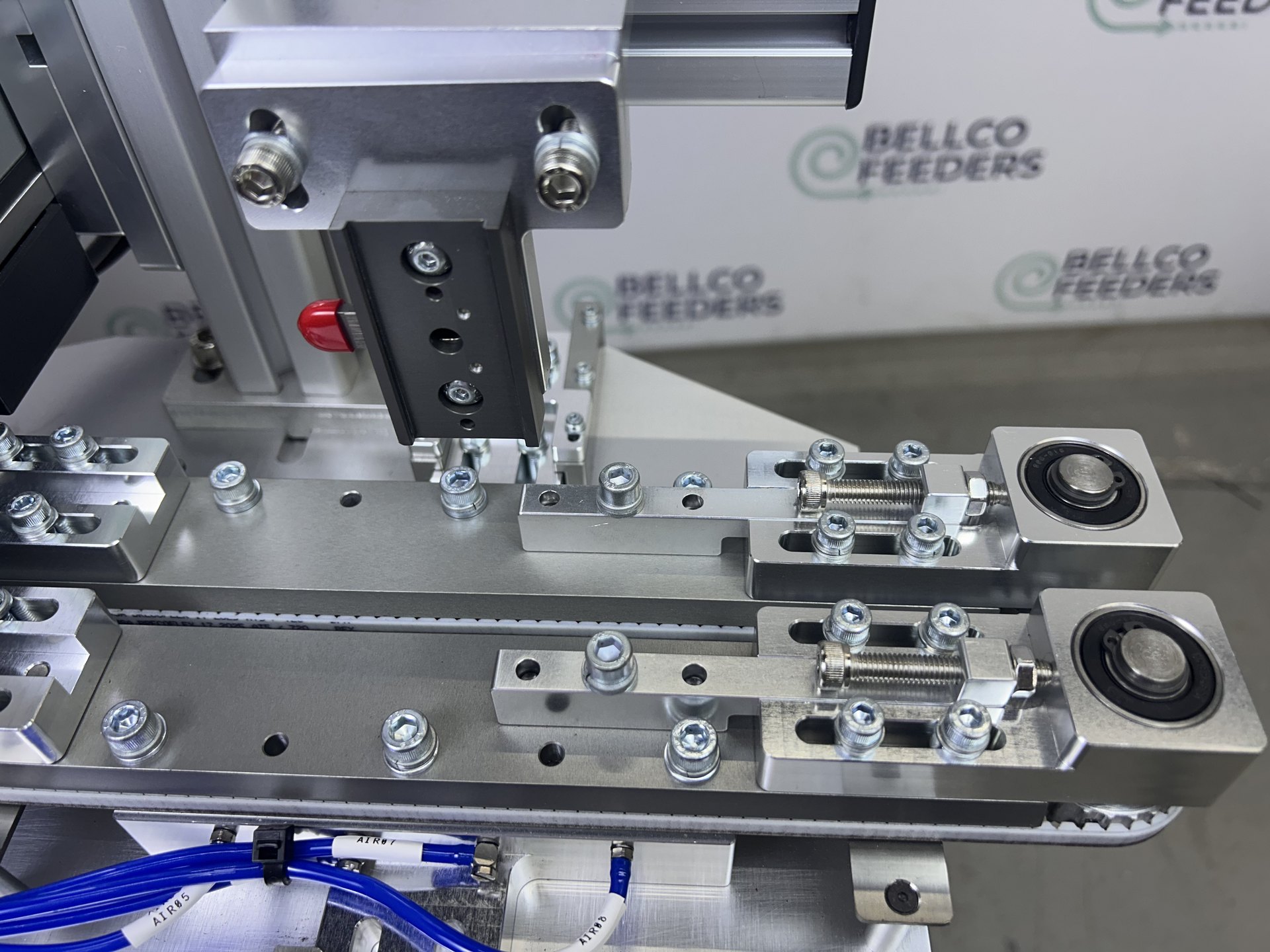
A 500mm polyurethane-coated bowl orients the terminals barrel-trailing and feeds them down a 355mm flat linear track. At the end of that track the parts transition onto a dual-belt conveyor Bellco designed and built in house. Two belts run in parallel along both sides of the part, gripping each terminal gently as it travels.
That is the whole trick. The belts move at a fixed, motor-controlled velocity, so speed is a setting rather than an emergent property of friction and queue length. Every terminal travels at the same speed as every other terminal, whichever variant it is and however many parts are behind it. The customer’s sensor and dispenser mount above the conveyor on a Bellco-built bracket that adjusts up, down, left, right and in rotation, so the dispense zone gets dialed in per variant at commissioning.
Where custom conveyors go wrong
The reason this one holds 120 PPM is the same reason most one-off conveyor designs do not: the details that only show up once you build one.
- Belt tension has to grip the smallest variant without crushing the largest. One number, eight parts.
- The drive ratio has to match the bowl outfeed exactly, or parts back up at the transition and you have reinvented the queue you were trying to escape.
- Side-rail spacing has to accept every variant’s geometry without being adjusted, because an adjustment is a changeover and a changeover is downtime.
All of it was solved in SolidWorks before the first piece of metal was cut, and the complete model went to the customer for approval before fabrication. At 120 parts per minute there is no room to debug in the field.
The question to ask about your own line
Does anything downstream fire on a signal rather than on the part physically arriving? A dispenser, a laser marker, a camera with a fixed exposure window, a reject gate. If the answer is yes, find out what velocity tolerance it needs — and find out before the feeder is specified rather than after it is installed. That single number decides whether you are buying a track or a conveyor.