
Engineering
One Frame, Five Feeders: What Vibration Isolation Actually Buys You
Five vibratory feeders on a single baseplate should be a bad idea. Here is the engineering that makes it work, and what it saves in floor space, cost and noise.
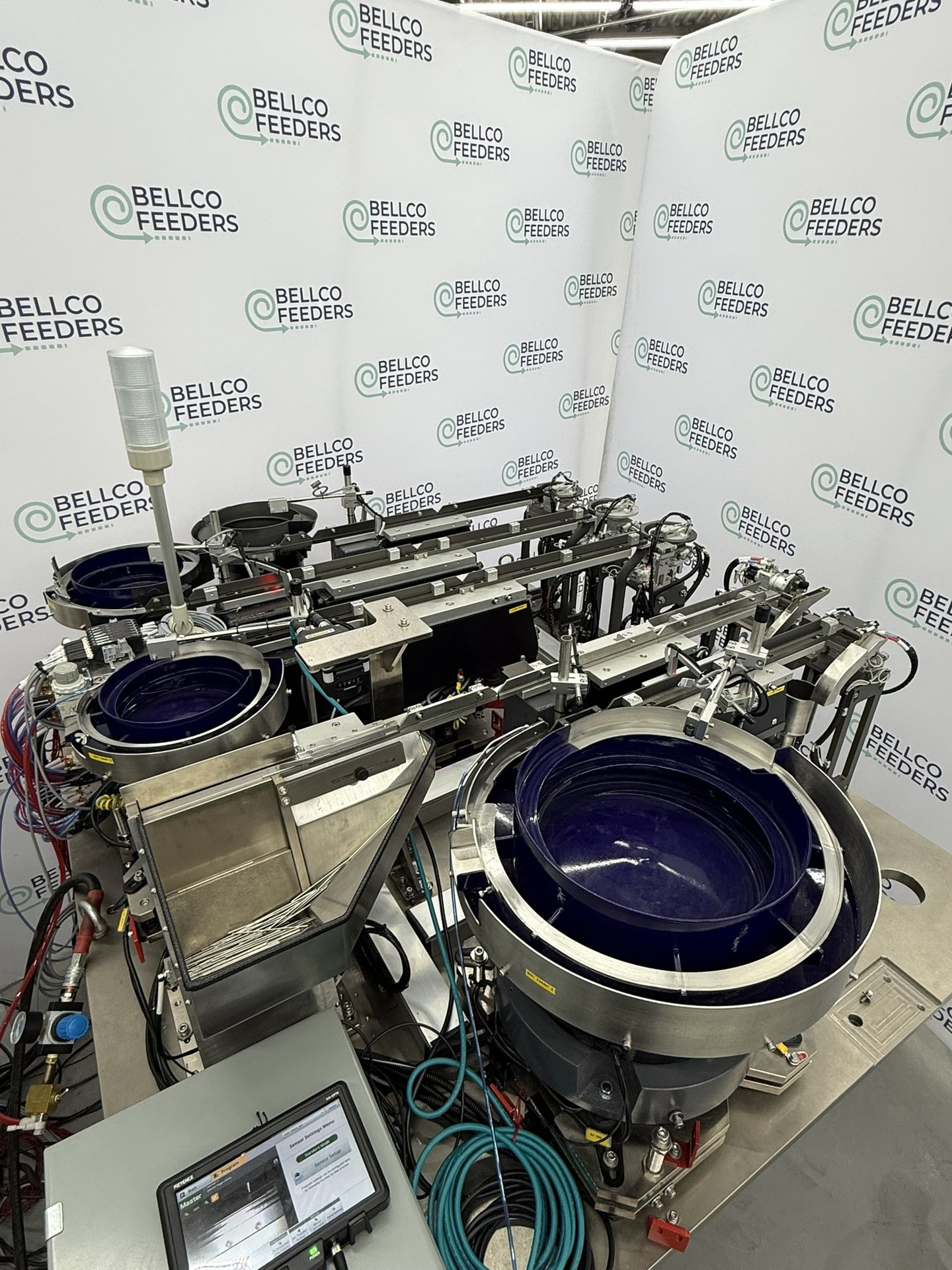
A machine integrator came to us with five parts that all had to reach the same robotic assembly cell. Four suited vibratory bowls; one was better handled by a step feeder. Different sizes, different orientations, different rates. The conventional answer is five separate feeder systems, each on its own baseplate, each finding its own square meter of a cell that is already tight.
They asked the question most integrators do not bother asking: could all five go on one shared baseplate?
Why that is normally a bad idea
A vibratory feeder works because it vibrates. Bolt two of them to the same plate of steel and each drive transmits through the frame into its neighbor. The neighbor’s effective amplitude changes, so its feed rate drifts. Run several at once and the frequencies interact: the frame stops being a mounting surface and starts being a coupling.
That is why the default is one feeder per frame. It is not tradition, it is the path of least engineering.
How the shared frame works
Every feeder sits on rubber-dampening isolators, and each one gets an individual sub-plate between it and the shared baseplate. The effect is that each feeder floats on its own mounting rather than being rigidly tied into the frame. Its vibration is absorbed before it can reach the shared steel, so it never arrives at the feeder next to it.
The result on that cell was four bowls — two 300mm, two 220mm — plus a tabletop step feeder, all on one 38mm nickel-plated steel baseplate, all running simultaneously, with no interference and no harmonic feedback between them.
The acoustic dividend
Five vibratory feeders running at once ought to sound like a factory. That system runs under 80 decibels with everything on. Three choices got it there, and only one of them is the isolators.
- Polyurethane bowl coatings. A bare stainless bowl rings. Roughly a millimeter of PU on the bowl absorbs the high-frequency component of vibratory noise at the surface that is making it — and it stops the bowl marking the parts while it is there.
- The same isolators that stop the crosstalk. Vibration that never reaches the frame is also sound that never reaches the frame, and a large flat baseplate is an efficient thing to radiate sound from.
- Acoustic shrouds around the noisier sections, which handle what is left rather than trying to do the whole job alone.
The practical test is not the number. It is whether two people can stand beside the cell and talk. On this one they can.
What the customer actually saved
One baseplate instead of five. One set of legs, casters and leveling feet instead of five. One installation instead of five, and one footprint in a robotic cell where floor space was the scarcest thing on the drawing. It also arrives as one machine to level, one machine to maintain and one machine to integrate, rather than five things that have to be positioned relative to each other on site.
The escapement detail that made the robot’s job easy
Each bowl outfeed ends in a horizontal rotating escapement, a Bellco design that holds the singulated part in a fixed pick position. The robot comes down from above and presses a pin through the bottom of the escapement, pushing the part up and out into its gripper. Because the escapement holds the part precisely during the press, the robot does not need vision to find it, and it does not need a tooling change to move between part variants — it just moves between escapements as the assembly sequence requires.
When a shared frame is the wrong call
This only pays when the feeders genuinely belong in the same place. If the cell layout puts two of them three meters apart, a shared baseplate stops being a saving and starts being a constraint you have to design around for the life of the line. The question to answer first is not “can they share a frame” but “do they want to be in the same place at all”.
If they do, send us the parts, the rates and the cell layout, and we will tell you what fits on one plate.