
Case Study
Dual Vibratory Bowl Feeder for Medical Device Assembly Delivers 30 Inspected Cap-and-Shaft Assemblies Per Minute
A light medical manufacturer needed a vibratory bowl feeder for medical device assembly that could feed, press and inspect precision caps and shafts. Bellco built a dual-bowl system that delivers 30 vision-inspected assemblies per minute.

The Challenge
A light medical manufacturer came to Bellco needing a vibratory bowl feeder for medical device assembly: one system to feed precision caps and shafts, press them together and pass every assembly through vision inspection at 30 assemblies per minute. The shafts came in two diameters, .282" and .249"–.252", and both had to run through the same bowl. Caps had to be presented threads-down for pressing, and all part-contact surfaces had to be 304 stainless steel.
The harder part was the schedule. A separate controls integrator was designing the vision system at the same time, so Bellco’s mounting points, camera clearances and trigger geometry had to be confirmed before either team cut steel. The system also had to fit a specific floor footprint, and every failed inspection had to be separated from good product mechanically, with no software workaround and no operator involvement.
The Solution
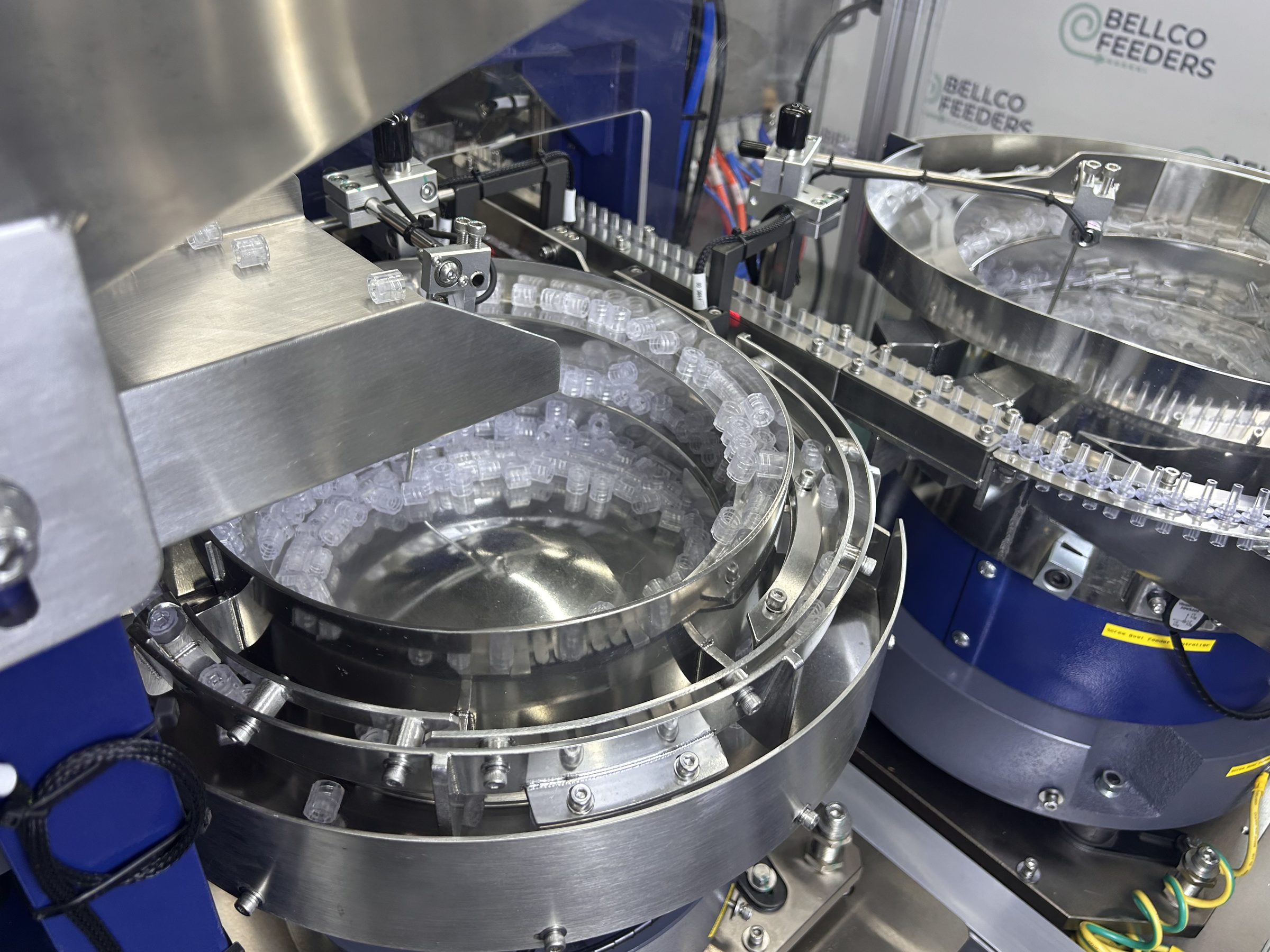
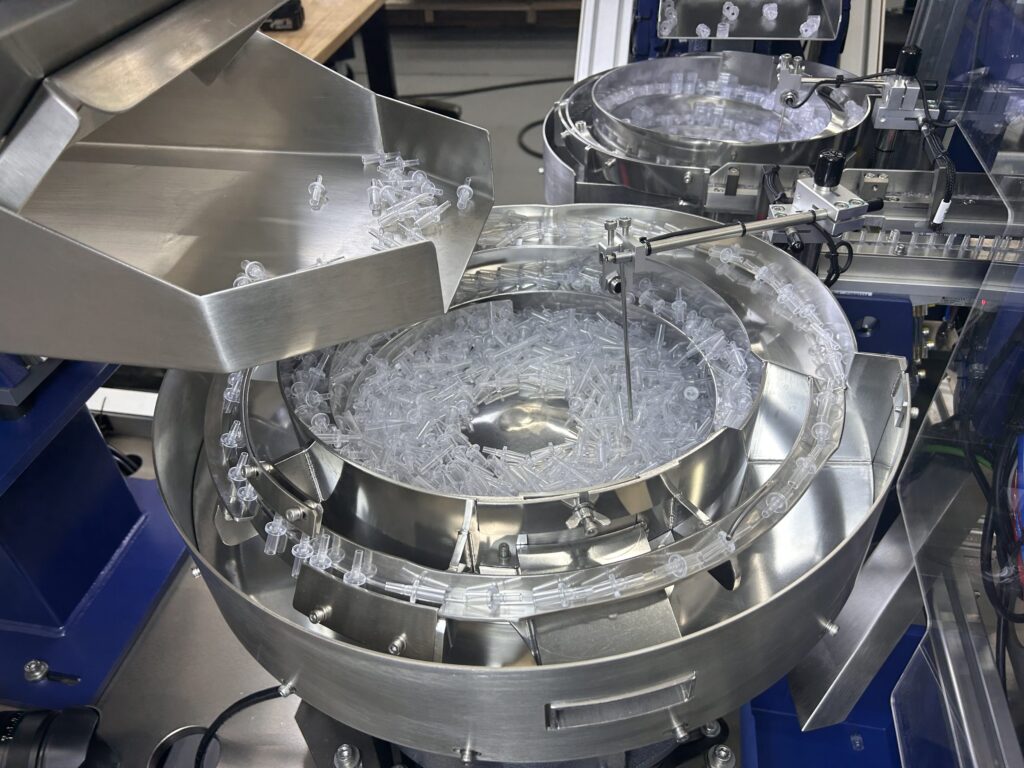
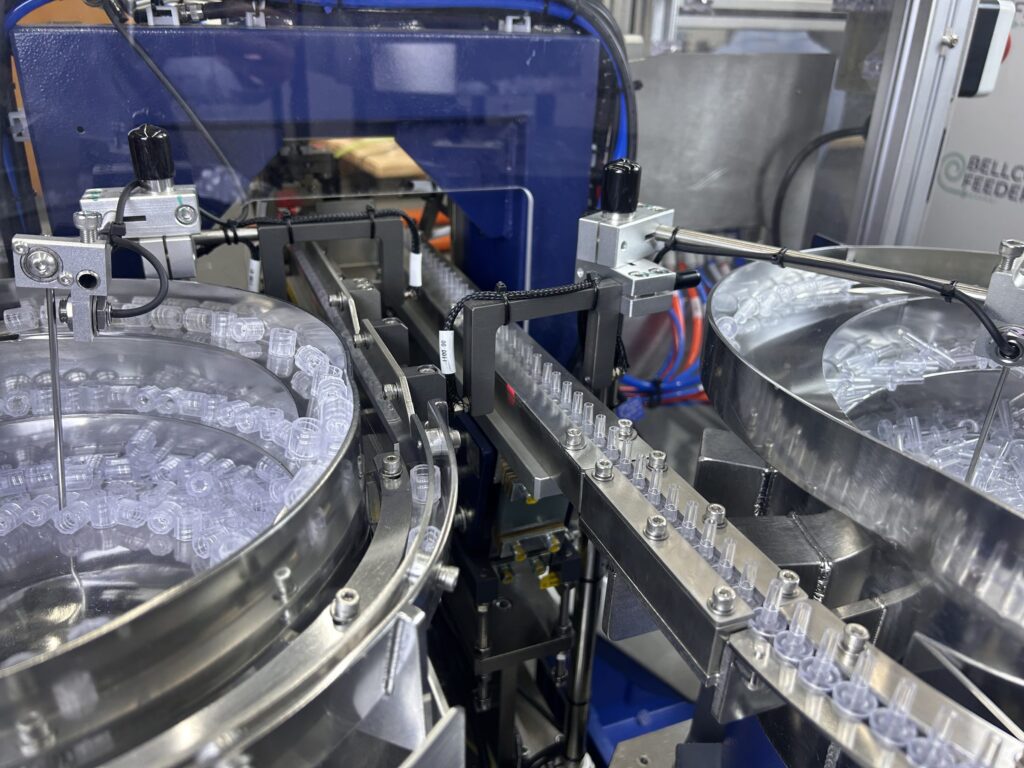
Bellco built two bowl feeders feeding a synchronized pressing station. The cap bowl is tooled to present every cap threads-down. The shaft bowl is tooled for both shaft diameters, .282" and .249"–.252", so one bowl covers the full spec. Holding tight diameter tolerances in a bowl comes down to tooling: track profiles, singulation geometry and presentation angles are designed in SolidWorks and proven with the customer’s own production parts before the system ships. All part-contact surfaces are 304 stainless steel.
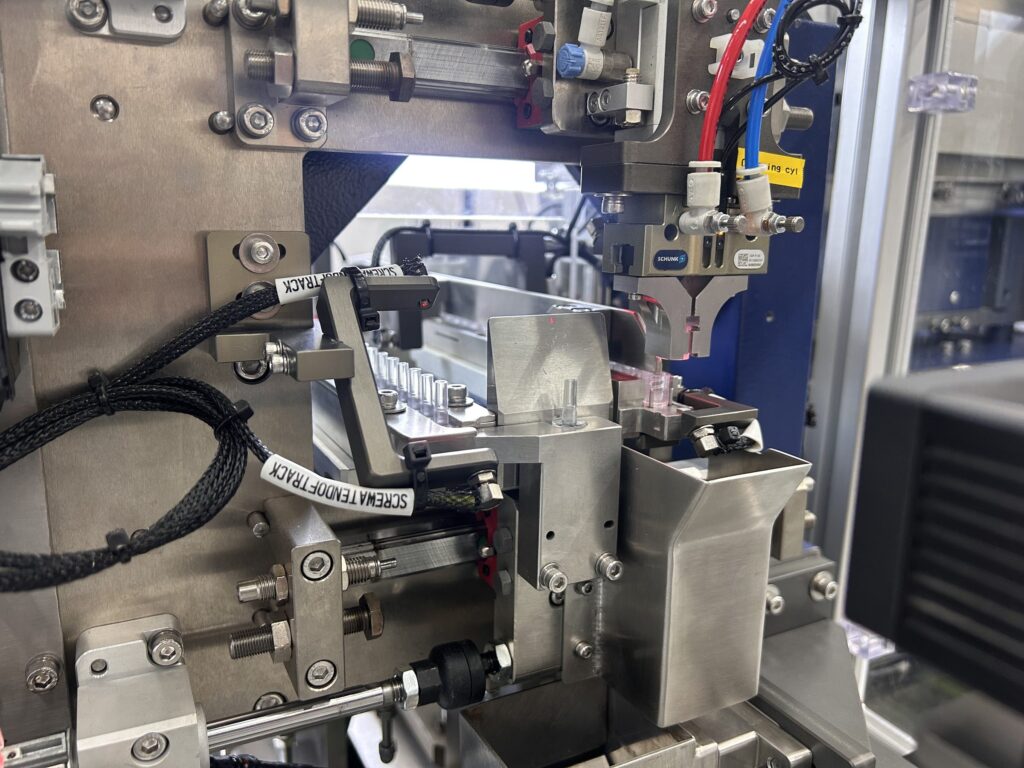
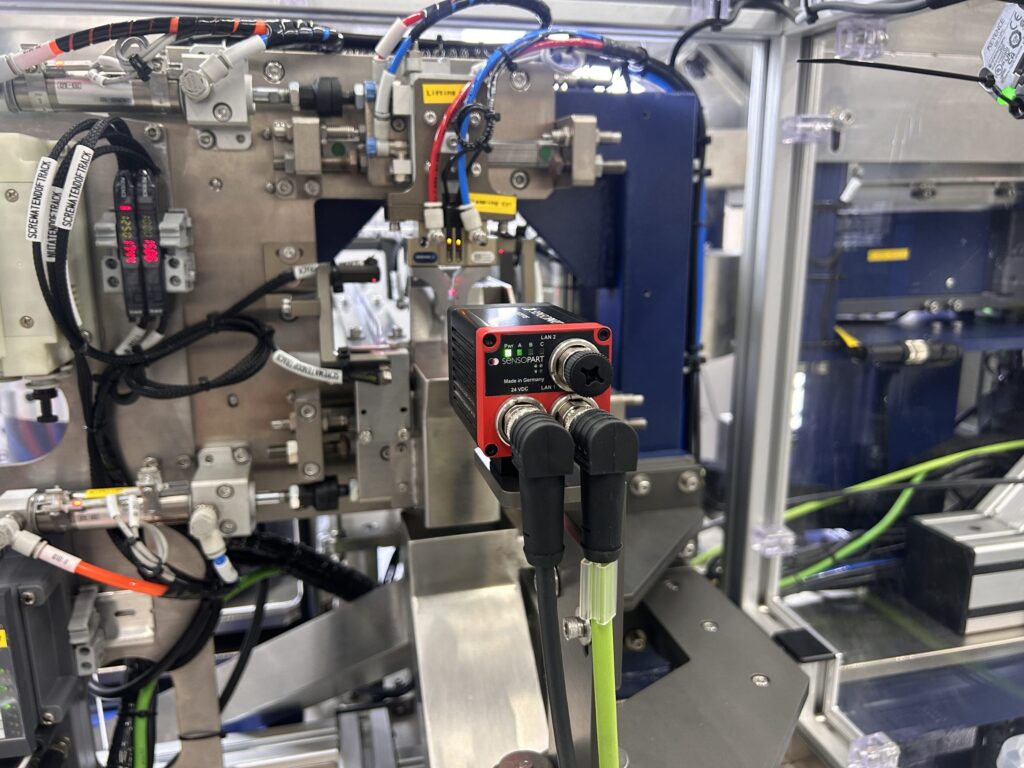
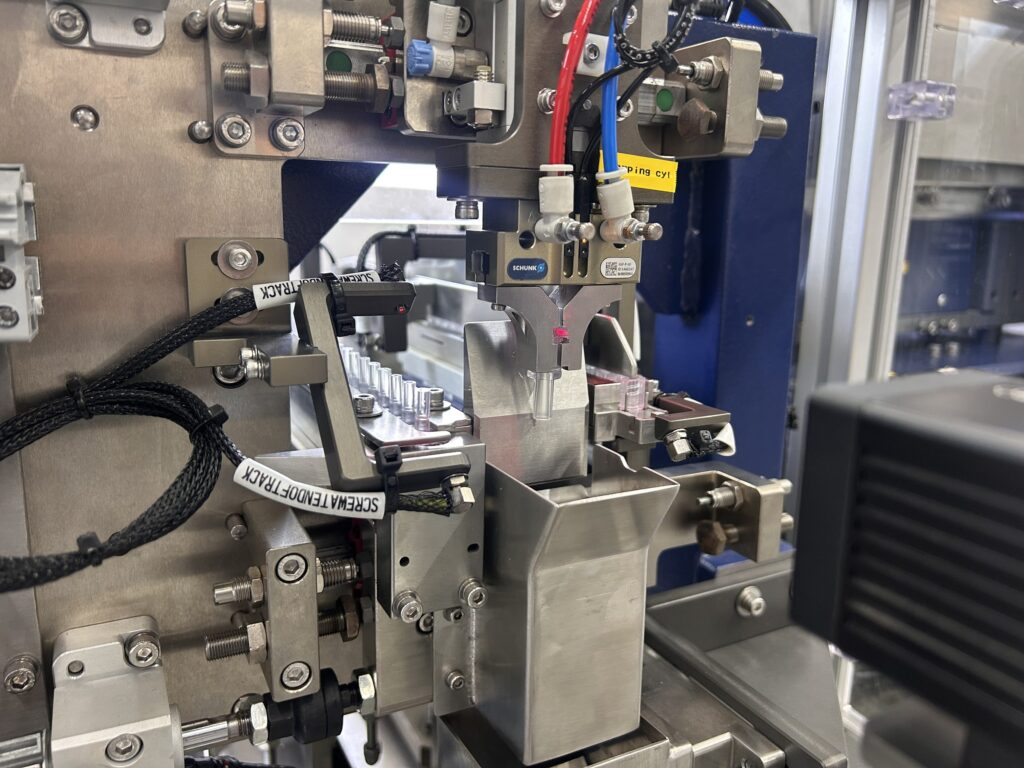
Each vibratory feeder delivers parts to the pressing station, which is timed to press one cap onto one shaft every 2 seconds, for 30 assemblies per minute. A Sensopart camera, supplied by the controls partner, checks cap seating depth on every assembly. Failed assemblies go through a Bellco-designed flip-door reject. Good assemblies collect in an indexed two-tote conveyor holding 15,000 assemblies per bin, and an angled roller conveyor unloads full bins without stopping production.
The full mechanical system was modeled in SolidWorks before fabrication. Bellco used the model to run formal design reviews with the controls integrator, covering camera mounting clearances, trigger interface geometry and timing, so the vision system could be designed around confirmed dimensions while both were built in parallel. A separate review with the end customer confirmed the footprint and signed off every mechanical detail. Bellco tested the system in house with customer-supplied parts and offered a live video run-off before shipment.
A Reject That Doesn’t Depend on Anyone Watching
When the vision system fails an assembly, a software flag alone isn’t enough on a medical line. If an operator is distracted or a timing edge case hits, rejected parts can end up mixed with good product. Bellco solved this in hardware. On every reject signal, a custom flip-door pivots to physically block the accepted-product bin and sends the failed assembly to the discard bin. There is no operator step and no software workaround, so separation happens whether anyone is at the machine or not. The flip-door was part of the SolidWorks model reviewed with both the controls partner and the customer, so its interface with the vision trigger was worked out before build.
Full System Overview
- Two bowl feeders: cap bowl (threads-down orientation) and shaft bowl (.282" and .249"–.252" shafts)
- 304 stainless steel on all part-contact surfaces
- Rate: 30 PPM, one pressed and inspected assembly every 2 seconds
- Synchronized cap-to-shaft pressing station
- Bellco flip-door reject: mechanical separation on every failed inspection
- Sensopart vision camera (controls partner) checks cap seating depth on 100% of assemblies
- Indexed 2-tote conveyor, 15,000 assemblies per bin, plus angled roller conveyor for full-bin unload
- Full SolidWorks model, design-reviewed with controls partner and end customer before fabrication
The Build
Have a similar project in mind?
Send us the part, the rate, and what has to happen to it downstream. An engineer will come back inside five business days.